Last week, a group of experts from across civil society, academia, the healthcare sector and government met online for a workshop to discuss the global architecture for Pandemic Prevention, Preparedness and Response (PPPR). Happening during the latest rounds of negotiations on the final (and crucial) annex of the World Health Organization’s Pandemic Agreement, and two weeks before the UN high-level meeting (UNHLM) on PPPR, this was a timely opportunity to discuss the potential, shortcomings, and requirements for an effective and equitable response to future pandemics.
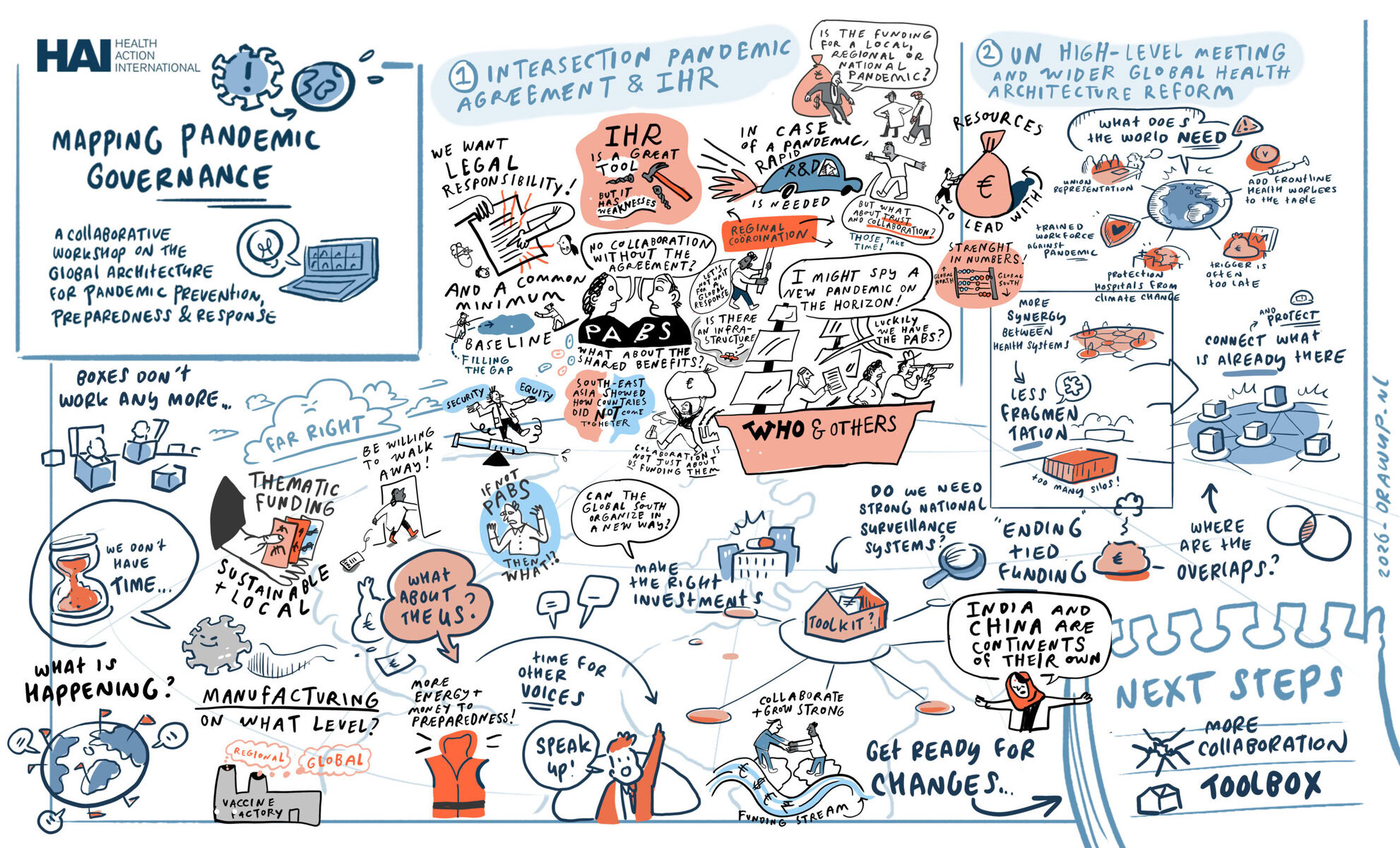
Organised as part of the Medical Innovations for All (MIFA) consortium, the session was given an extra bit of sparkle with the presence of two professional illustrators, who captured the rich discussion in an accessible and engaging sketch. In doing so, we made the conversation come to life and demonstrated the connections and overlaps of what is a broad and complicated issue.
To try and cover as much ground as possible in a limited amount of time, our assembled experts split into two groups, which were facilitated by colleagues from HAI and MIFA partner, Medicines Law & Policy. These groups covered separate pillars of the PPPR architecture. After that we came back together in a final session to share the results of our discussions and look for a common way forward.
Group 1 – Pandemic Agreement and International Health Regulations
The departure point for deliberations in Group 1 was the intersection between the Pandemic Agreement and International Health Regulations (IHR), and how it reflected tensions in the architecture of PPPR.
Participants agreed on the differing nature of the two instruments and how they should complement each other but acknowledged a lack of trust and collaboration as major obstacles. Ongoing negotiations around Pathogen Access and Benefit Sharing, the aforementioned final annex of the Pandemic Agreement, were considered by many as critical for a full-fledged international instrument that goes beyond a common minimum baseline.
Recent regional integration and cooperation efforts, especially in the Global South, were also mentioned as examples of how global efforts must consider actual needs on the ground. This was especially true when it came to the need to establish sustainable (non-tied) funding streams and promote local manufacturing capabilities that cater to local demand.
There was consensus in linking the reform of global health architecture with improved PPPR capabilities by realigning institutional mandates and assigning clearer responsibilities. For some, the UNHLM political declaration on PPPR could be an important step towards better, deeper and more fruitful coordination.
Group 2 – Deeper into Global Health Architecture Reform
The discussion in Group 2 delved deeper into the reform of the global health architecture, particularly in light of the UNHLM. The discussion opened with the observation that health programming remains vertical, with little horizontal communication between pillars, which means potential synergies are missed. This fragmentation would need to be addressed.
Several group members also referred to the problem of funding, with one participant pointing out its often-reactive nature, released once a crisis has escalated, and dependent on vulnerable donor money. As also observed by Group 1, tied funding compounds this, adding to transaction costs and burdens that work against the flexibility PPPR requires.
Participants also argued for a broader view of engaging the social, commercial and environmental determinants of health, which suggests bringing non-health stakeholders into the conversation. A particularly interesting suggestion was looking to transitions in other sectors, such as the shift to renewable energy, and how they may offer lessons on how systems change at scale.
A group that was repeatedly flagged as under-represented in current negotiations around PPPR and global health architecture reform were front-line healthcare workers, who lack a legitimate seat at the table despite carrying the response to pandemics. It was also noted that leadership from Africa, Latin America and other regions was disconnected from the global architecture.
Conclusions
In coming back together in the final session, it was fairly clear that Group 1’s focus on the Pandemic Agreement–and IHR and Group 2’s discussions on broader global health architecture reform had arrived at the same structural concerns. Mistrust between actors, vertical and siloed programming, and funding that is reactive, tied, and donor-dependent are issues that must be addressed.
Across both discussions, participants called for a shift toward more distributed, regionally grounded leadership, particularly from the Global South, and for the meaningful inclusion of front-line healthcare workers and non-health stakeholders whose perspectives remain marginal (at best) in current negotiations. Sustainable, flexible financing and local manufacturing capacity were seen as preconditions for a more resilient system, not optional add-ons.
The opportunities to address these issues, whether through global health architecture reform, the UNHLM meeting or elsewhere, will depend on whether reform efforts can move beyond siloed, top-down approaches toward the kind of cross-sectoral, cross-regional collaboration participants described as still largely absent.
Some top level recommendations that emerged from the workshop were:
- Distributed leadership, with stronger regional voices.
- Make financing more flexible, and end tied funding.
- Stronger national level surveillance systems and other health capacities (tech transfer)
- Toolkit that countries can adapt to their own context on can be done to close implementation gaps and operationalise health advice.
- Cross-country knowledge sharing platform to share workable solutions and lessons learned/best practices.
- Reframe some traditional perceptions regarding R&D and access to innovation.
We are very grateful to all the participants for their engagement and openness during the workshop, and look forward to working with everyone involved (and whoever wants to join the effort) to develop the ideas that had been shared.
Meanwhile, below you can see how the discussion took shape in a visual way!